
Overlapping pairs
When exactly two connectors share the same unordered endpoint pair — irrespective of arrow direction, so a → b plus b → a counts as a pair — gridgram automatically rotates each line's connection points on the node circles so the two arrows emerge in mirrored positions and run side by side instead of stacking on top of each other.
The treatment is only applied when a pair would otherwise render as two straight lines on top of each other. Connectors with explicit waypoints: [...] are left alone — the author has already decided how they route — and connectors that the router bends around obstacles are left alone too.
Example
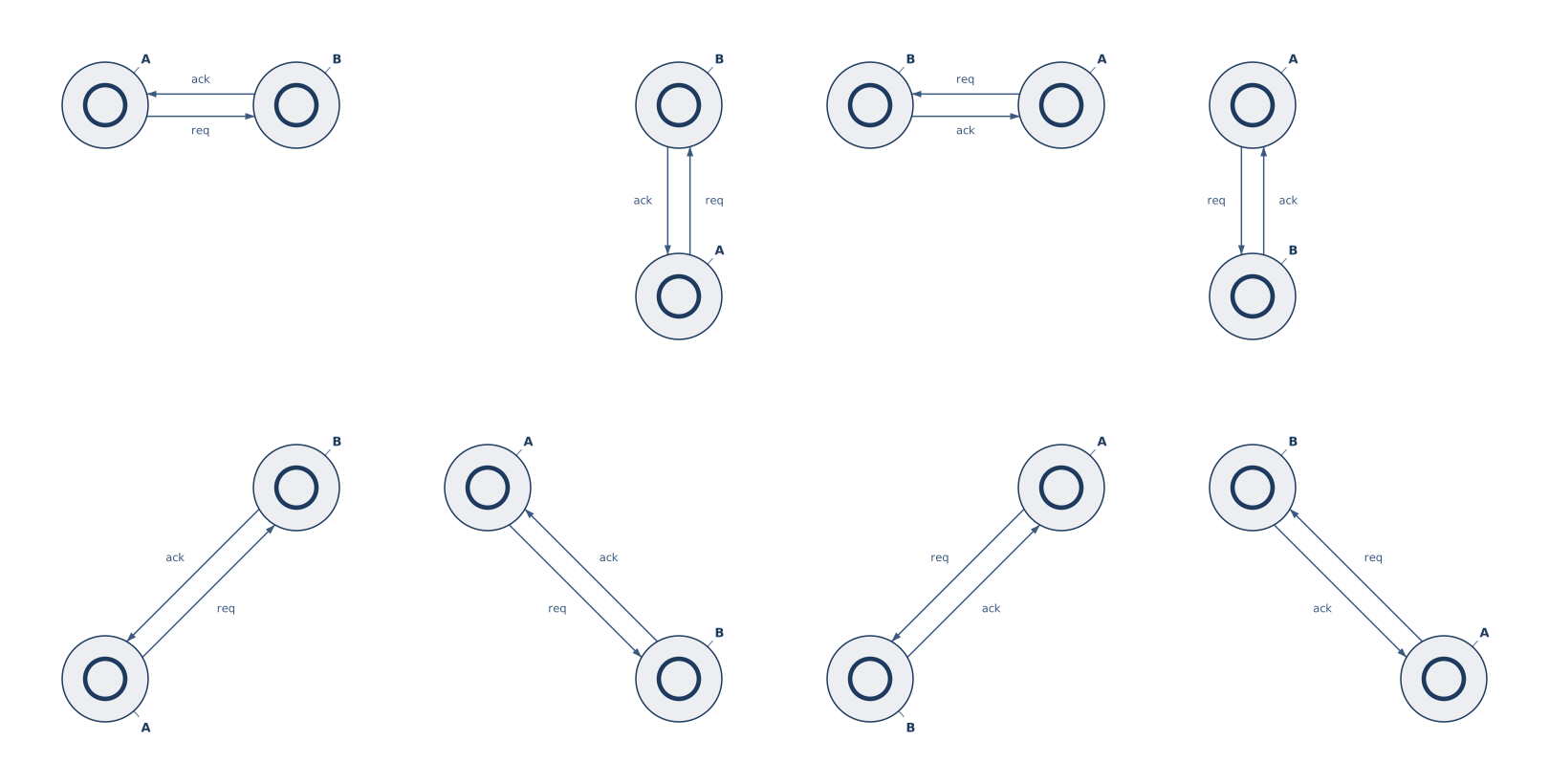
All 16 connectors above are declared as plain a --> b "label" lines. Because every node pair has exactly two connectors, each pair is auto-split — once for req, once for ack — into mirrored parallel lines. The pattern works uniformly in all 8 directions (E, N, W, S and the 4 diagonals).
Geometry
The lines remain strictly straight. What changes is the angle on each node's circle where the line attaches:
            ╱─── req ───╲
node A ┤ rotated by ±15°  ├ node B
╲─── ack ───╱- Each member of the pair rotates its connection point by 15° on the participating node circles, in mirrored directions.
- For default circle nodes (radius = 22.5% of
cellSize), this works out to a perpendicular separation of ≈ 12% ofcellSizebetween the two paired arrows — visibly distinct without looking unrelated. - The rotation is computed in the canonical (alphabetically ordered) endpoint frame, so
a → bandb → astill come out on opposite canonical sides regardless of arrow direction.
Because the path is still a single straight segment, connector labels, the JSON output, and downstream consumers all see normal-shaped geometry; only the SVG polyline endpoints move.
Labels follow the line
Connector labels are placed against the rotated line using the same candidate-segment search as any straight connector. No author action required.
Three or more — the overlap is treated as an error
The auto-split only works for exactly two connectors. If three or more connectors share the same unordered endpoint pair, gridgram draws all of them as straight lines (so the first two stack on top of each other) and marks the 3rd and beyond with the error color. A connector-overlap diagnostic is emitted with a suggestion to either remove the duplicate or add explicit waypoints.
a --> b "first"
a --> b "second"
a --> b "third"   # rendered in error color + diagnostic
To fix: keep at most two connectors between any pair of nodes, or give the extras explicit waypoints so they take a deliberate path:
a --> b "first"
a --> b "second"
a --> b "third" {
  waypoints: [{ col: 2, row: 1.5 }],
}
Opting out
A pair with at least one of the two connectors carrying explicit waypoints: [...] is not auto-split — the explicit routing is taken as the author's intent and the other connector renders as a straight line. Use this when you want one connector to follow a specific path and the other to stay direct.